
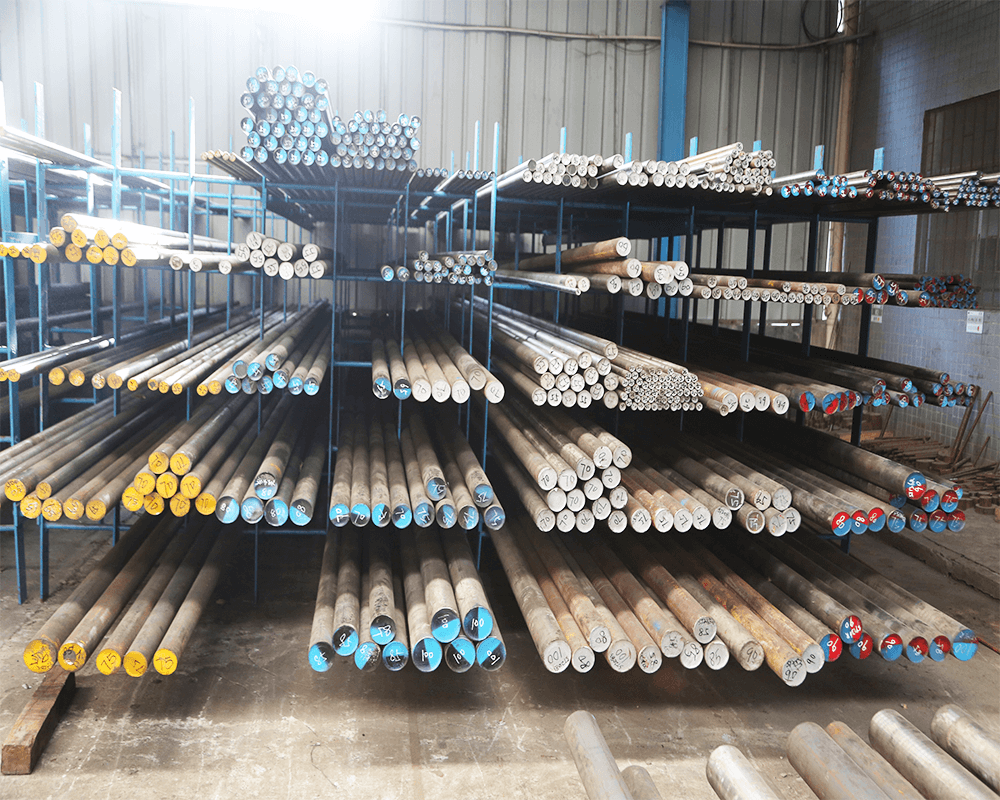
Alloy steel
Alloy steels are utilized in a wide range of industries and applications, including automotive, aerospace, construction, oil and gas, manufacturing, and more.
They can be tailored to meet specific requirements, making them versatile and valuable materials for engineers and designers.
The choice of alloying elements and their proportions depends on the intended use and the desired properties of the alloy steel.
Application of alloy steel
Due to its enhanced properties compared to plain carbon steel, finds application in a wide range of industries and specialized applications.
The specific usage of alloy steel varies depending on the alloying elements and properties required for a particular application. Here are some common uses of alloy steel:
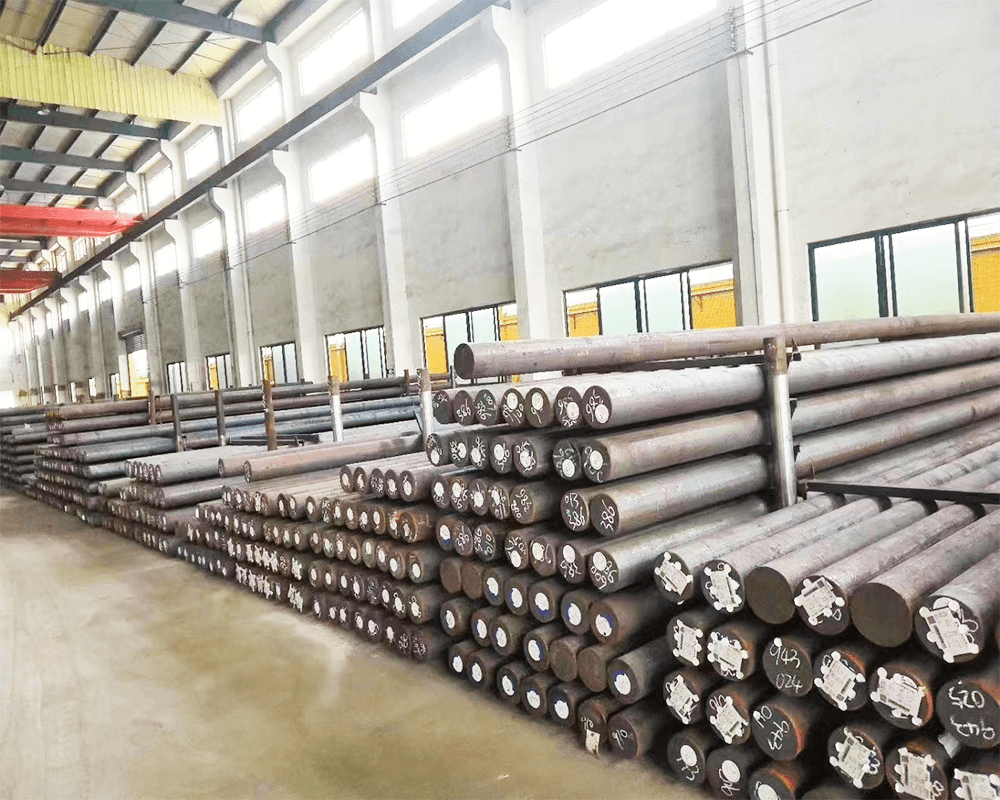
WE OFFER
| Steel Type | GERMANY | AISI | Sweden | JAPAN | FUSHUN | Grade | Hardness HB or HRC | Ultrasonic TEST | Hot rolled plate sizes range | Hot forged plate and block sizes range | Round bar sizes range |
| Alloy steel | 1.7225 | 4140 | — | SCM440 | — | 42CrMo4 | Quenched +Tempered | Sep1921-84 D/d | Thick 20-90mm x Width 200-610mm | Thick 100-800mm x Width 120-1500mm | Machined Dia 6-1000mm |
| 1.6582 | 4340 | — | SNCM 439/SNCM8 | — | 40CrNi2MoA | Quenched +Tempered | Sep1921-84 D/d | Thick 20-90mm x Width 200-610mm | Thick 100-800mm x Width 120-1500mm | Machined Dia 6-1000mm | |
| 1.6523 | 8620 | — | JIS G4103 | — | 20CrNiMo | Quenched +Tempered | Sep1921-84 D/d | Thick 20-90mm x Width 200-610mm | Thick 100-800mm x Width 120-1500mm | Machined Dia 6-1000mm | |
| 100Cr6 1.3505 | 52100 | — | SUJ2 | — | GCr15 | Annealed or Normalized | Sep1921-84 D/d | Thick 20-90mm x Width 200-610mm | Thick 100-800mm x Width 120-1500mm | Machined Dia 6-1000mm |
Aerospace: Alloy steel is used in the aerospace industry for components that require high strength, durability, and resistance to extreme temperatures and stresses. Examples include aircraft landing gear, engine components, and structural parts.
Automotive: Alloy steel is employed in various automotive components, such as engine parts, gears, axles, and drive shafts, to improve performance, durability, and fuel efficiency.
Construction: Alloy steel is used in construction for specialized applications, such as high-strength bolts, fasteners, and structural components like high-strength beams and columns.
Oil and Gas: Alloy steel is used in the oil and gas industry for drilling equipment, pipelines, and valves, where corrosion resistance and high strength are crucial.
Power Generation: Alloy steel is used in power plants for turbine blades, generator components, and high-temperature boiler parts due to its ability to withstand high temperatures and pressures.
Marine: Alloy steel is used in shipbuilding for hulls, propeller shafts, and other critical components that require high strength and corrosion resistance in a marine environment.
Defense and Military: Alloy steel is used in the manufacture of military vehicles, armor, and weaponry due to its ability to withstand impact and wear.
Tool and Die Making: High-speed and tool steel alloys are used to make cutting tools, molds, and dies used in manufacturing processes.
Mining and Construction Equipment: Alloy steel is used for the fabrication of heavy machinery components like excavator buckets, bulldozer blades, and crushing equipment due to its durability and wear resistance.
Medical Devices: Stainless steel alloys, a type of alloy steel, are used in the medical industry for surgical instruments, implants, and equipment due to their corrosion resistance and biocompatibility.
Automotive Racing: Alloy steel is used in high-performance racing applications, such as Formula 1 and NASCAR, for engine components, suspension parts, and chassis reinforcement.
Cutlery and Kitchen Tools: Stainless steel, which is an alloy steel, is commonly used in the production of kitchen knives, utensils, and cookware due to its corrosion resistance and hygiene properties.
Firearms: Some firearms and firearm components are made from alloy steel for strength, durability, and resistance to wear and corrosion.
The choice of alloy steel for a specific application depends on factors like required strength, hardness, corrosion resistance, temperature resistance, and other specialized properties necessary to meet the demands of the industry or function.
Some common alloying elements used in alloy steel production include:
Chromium (Cr): Chromium is often added to improve corrosion resistance and to create stainless steel alloys. It also enhances hardenability and wear resistance.
Nickel (Ni): Nickel is commonly added to increase toughness and impact resistance. Nickel alloys are used in applications that require high-temperature strength and corrosion resistance.
Manganese (Mn): Manganese is used to improve the hardenability of steel and to remove impurities. It can also enhance strength and wear resistance.
Vanadium (V): Vanadium increases the strength, toughness, and wear resistance of steel. It is commonly used in tool steels and high-strength low-alloy (HSLA) steels.
Molybdenum (Mo): Molybdenum is often added to improve the high-temperature strength and creep resistance of steel. It is used in applications such as aerospace and high-temperature structural components.
Tungsten (W): Tungsten is used to increase the hardness and wear resistance of steel, making it suitable for cutting tools and high-speed steel applications.
Silicon (Si): Silicon is added to improve the electrical and magnetic properties of steel, and it can also act as a deoxidizer.
Cobalt (Co): Cobalt is used in some specialized alloys, especially in the production of high-speed and high-temperature steels.
Aluminum (Al): Aluminum can be added to improve the grain size control and reduce the risk of steel embrittlement during heat treatment.
The American Iron and Steel Institute (AISI) has developed a numbering system to classify and identify various types of steel alloys.
This AISI/SAE steel grade designation system is widely used in North America and serves as a common way to categorize different steel compositions based on their chemical composition and properties.
In this system, alloy steels are typically designated with a four-digit number. The first digit indicates the major alloying elements or steel group, and the following two digits represent the approximate percentage of the alloying element in the steel. The last digit is often used to denote specific variations or modifications within the alloy group.
For example, let’s break down the AISI/SAE designation for a common alloy steel:
AISI 4140: The first digit “4” indicates that it belongs to the chromium-molybdenum (chromoly) steel group.The next two digits “14” represent the approximate percentage of chromium (0.4%) in the alloy.The last digit “0” is used to denote variations or subtypes within the 4140 alloy group.
AISI/SAE steel designations cover a wide range of alloy steels with various compositions, each designed for specific applications and properties. Some examples include:
AISI 4340: A high-strength, nickel-chromium-molybdenum steel often used in aerospace and automotive applications.
AISI 316L: A stainless steel alloy known for its corrosion resistance, commonly used in medical devices and marine equipment.
AISI 52100: A high-carbon chromium alloy steel used for making ball bearings.
AISI 8620: A low-alloy steel with good case-hardening properties, often used in gear manufacturing.
These are just a few examples, and there are many more AISI/SAE steel designations, each tailored to specific industrial needs and performance requirements.
Other countries and regions have their own classification systems and designations for alloy steels, distinct from the AISI/SAE system used in North America. These systems are often developed by national or international standards organizations and are used to categorize and specify steel alloys based on their chemical compositions and properties. Here are a few examples:
European Union (EN): In Europe, steel alloys are often classified according to the EN standards developed by the European Committee for Standardization (CEN). The EN system provides a numerical designation, such as “EN 10083-1,” where the numbers and letters in the code convey information about the steel’s composition, properties, and intended use.
Japan (JIS): The Japanese Industrial Standards (JIS) system is widely used in Japan and includes a classification system for steel alloys. For example, “JIS G4105 SCM440” represents a specific steel alloy used for structural and machinery parts.
Germany (DIN): Germany’s national standardization organization, Deutsches Institut für Normung (DIN), has its own system for classifying steel alloys. For instance, “DIN 1.2379” refers to a high-carbon, high-chromium cold-work tool steel.
United Kingdom (BS): The British Standards Institution (BSI) has its own system for categorizing steel alloys. An example is “BS 970 080M40,” which corresponds to a medium carbon steel often used for engineering components.
China (GB): China uses the GB (Guobiao) standard system to classify steel alloys. For instance, “GB 20CrMnTi” is a low-alloy steel used for gears and other mechanical components.
ISO (International Organization for Standardization): ISO has developed a globally recognized system for classifying steels. Examples include “ISO 683-17 20MnCr5” for a case-hardening steel and “ISO 4957 1.2344” for a high-alloy tool steel.
Many other countries and regions have their own steel classification systems. These systems are essential for ensuring that steel materials meet specific quality and performance standards in various industries and applications around the world. It’s important to consult the relevant standards and specifications when working with steel in different regions to ensure that the right materials are used for specific purposes.
Alloy steel is a broad category of steel that includes various grades with different alloying elements to enhance specific properties, such as strength, hardness, corrosion resistance, and wear resistance.
Alloy steel grades are designated using both the AISI (American Iron and Steel Institute) system, commonly used in North America, and the DIN (Deutsches Institut für Normung – German Institute for Standardization) system, commonly used in Germany. Here are some common alloy steel grades along with their equivalents in both the AISI and DIN systems:
AISI Alloy Steel Grades:
AISI 4140 (DIN 1.7225): AISI 4140 is a versatile chromium-molybdenum alloy steel known for its high tensile strength and toughness. It is used in a wide range of applications, including machinery parts, automotive components, and oil and gas industry equipment.
AISI 4340 (DIN 1.6565): AISI 4340 is a nickel-chromium-molybdenum alloy steel with excellent toughness and fatigue resistance. It is often used in applications requiring high strength, such as aircraft landing gear and crankshafts.
AISI 8620 (DIN 1.6523): AISI 8620 is a low-alloy nickel-chromium-molybdenum steel known for its case-hardening properties. It is used in applications like gears, camshafts, and other parts requiring wear resistance and surface hardness.
AISI 52100 (DIN 1.3505): AISI 52100 is a high-carbon chromium alloy steel commonly used for manufacturing ball bearings and roller bearings.
AISI 6150 (DIN 1.8159): AISI 6150 is a chromium-vanadium alloy steel known for its toughness and excellent fatigue resistance. It is used in applications such as springs and automotive suspension components.
AISI 4340V: This variant of AISI 4340 is vacuum degassed for improved cleanliness and is used in critical aerospace applications.
DIN Alloy Steel Grades:
DIN 42CrMo4 (AISI 4140): DIN 42CrMo4 is the DIN equivalent of AISI 4140. It is a versatile chromium-molybdenum alloy steel used in a wide range of applications.
DIN 34CrNiMo6 (AISI 4340): DIN 34CrNiMo6 corresponds to AISI 4340 and is known for its toughness and high fatigue resistance.
DIN 20CrNiMo (AISI 8620): DIN 20CrNiMo is the DIN equivalent of AISI 8620 and is often used for gears and other parts requiring wear resistance.
DIN 100Cr6 (AISI 52100): DIN 100Cr6 corresponds to AISI 52100 and is used for the production of ball bearings and roller bearings.
DIN 50CrV4 (AISI 6150): DIN 50CrV4 is the DIN equivalent of AISI 6150 and is often used in spring and suspension applications.
DIN 31CrMoV9: This alloy steel is used in applications requiring high tensile strength and impact resistance, such as crankshafts and connecting rods.
These are just a few examples of alloy steel grades that have both AISI and DIN designations.
Alloy steel selection depends on the specific application and required properties, including strength, toughness, wear resistance, and corrosion resistance. Engineers and manufacturers choose the appropriate grade based on their specific needs.
Ask for quote