
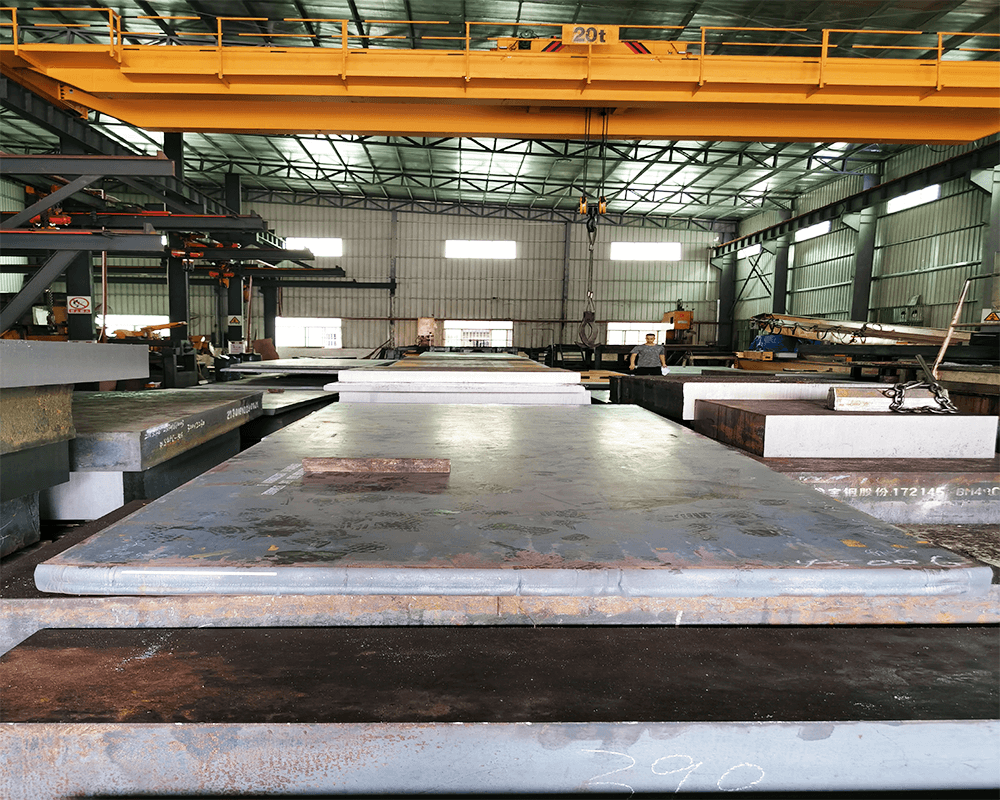
CARBON steel
Carbon steel is also known for its ability to be heat-treated to modify its properties further. Heat treatment processes like quenching and tempering can increase hardness and strength or improve toughness, depending on the desired characteristics.
It is a fundamental material used in various industries and applications due to its strength, affordability, and ease of fabrication.
Its properties can be tailored through heat treatment, and it serves as the base material for the development of more specialized steel alloys with enhanced properties.
Application
Carbon steel is a versatile and widely used material with a broad range of applications due to its excellent combination of strength, durability, affordability, and ease of fabrication. Here are some common and important uses of carbon steel:
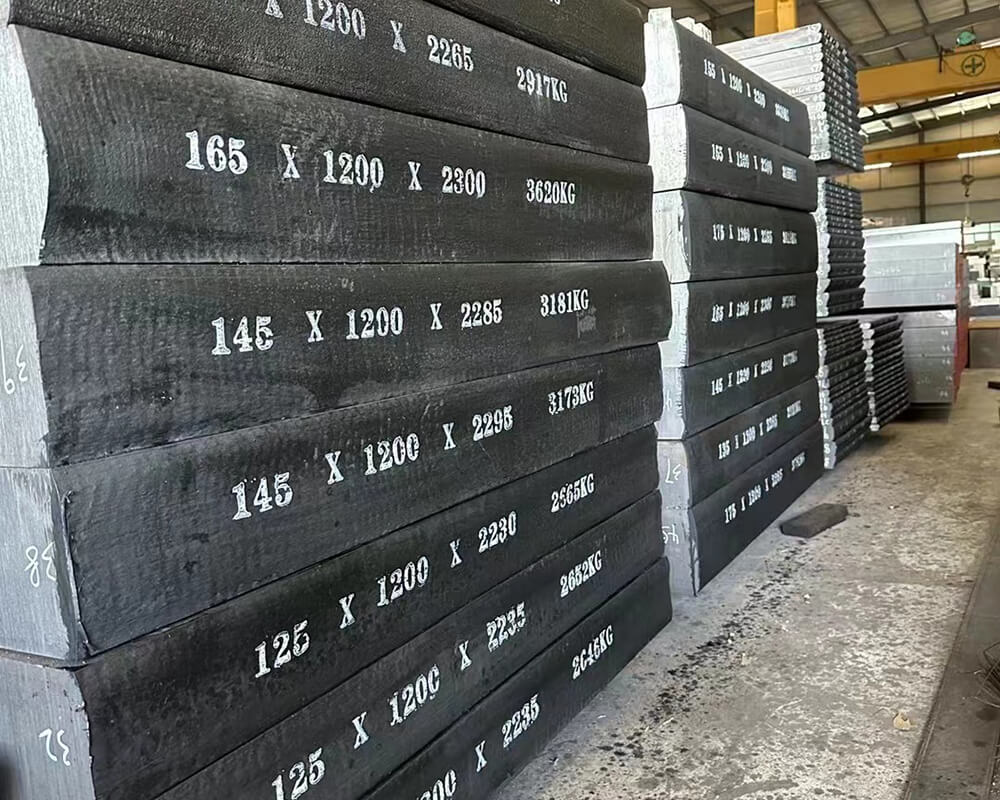
WE OFFER
| Steel Type | GERMANY | AISI | Sweden | JAPAN | FUSHUN | Grade | Hardness HB or HRC | Ultrasonic TEST | Hot rolled plate sizes range | Hot forged plate and block sizes range | Round bar sizes range |
| Carbon steel | C45 | 1045 | — | S45C | — | 1045 | Annealed ≤230HB | Sep1921-84 D/d | Thick 10-200mm x Width 1800-2300mm | Black surface Dia.10-400mm | |
| 1.1206 | 1050 | — | S50C | — | 1050 | Annealed ≤230HB | Sep1921-84 D/d | Thick 10-200mm x Width 1800-2300mm | Black surface Dia.10-400mm |
Construction: Carbon steel is a key material in the construction industry. It is used for structural components such as beams, columns, and girders in buildings, bridges, and infrastructure projects.
Automotive: Carbon steel is used in the manufacturing of various automotive components, including chassis and body panels, as well as engine parts and suspension systems.
Pipelines: Carbon steel pipes are commonly used for transporting liquids and gases in various industries, including oil and gas, water supply, and sewage systems.
Machinery and Equipment: Carbon steel is used in the fabrication of machinery and equipment, including gears, axles, shafts, and bearings.
Tools: Many hand tools and cutting tools are made from high-carbon and medium-carbon steel due to their hardness and durability. Examples include wrenches, hammers, chisels, and drills.
Agriculture: Carbon steel is used in the construction of agricultural equipment such as plows, harrows, and tractor components.
Shipbuilding: Carbon steel is used extensively in the shipbuilding industry for the construction of ship hulls, frames, and other structural components.
Railroad Tracks: Carbon steel rails and ties are used in railroad track construction for durability and load-bearing capacity.
Infrastructure: Carbon steel is used in the construction of various infrastructure components, including street lighting poles, transmission towers, and water treatment plants.
Consumer Goods: Carbon steel is found in everyday consumer goods such as appliances, cutlery, and kitchen utensils.
Energy Industry: Carbon steel is used for the manufacturing of power generation equipment, including turbines, generators, and boiler systems.
Storage Tanks: Carbon steel is used in the construction of storage tanks for various liquids and gases, including petroleum products and chemicals.
Springs: High-carbon and alloyed carbon steels are used to manufacture springs in various applications, from automotive suspensions to industrial machinery.
Construction Reinforcement: Carbon steel bars (rebar) are used to reinforce concrete structures, such as buildings and bridges.
Railway Tracks: Carbon steel rails and ties are used in railway track construction for their durability and load-bearing capacity.
It’s important to note that the specific grade and type of carbon steel chosen for a particular application can vary based on the required properties, such as strength, hardness, corrosion resistance, and weldability.
Additionally, carbon steel can be modified through heat treatment processes to achieve specific performance characteristics to meet the demands of different applications.
Carbon steel is classified into three main categories based on its carbon content:
Low Carbon Steel: Also known as mild steel, low carbon steel contains a relatively low percentage of carbon, typically between 0.05% and 0.30%.
It is easy to form, weld, and machine, making it suitable for a wide range of applications, including structural components, sheet metal, pipes, and everyday items like screws and bolts.
Medium Carbon Steel: Medium carbon steel contains a carbon content ranging from approximately 0.30% to 0.60%. It has higher strength and hardness compared to low carbon steel but is still relatively easy to machine and weld. Medium carbon steel is commonly used in applications such as axles, gears, shafts, and forgings.
High Carbon Steel: High carbon steel contains a carbon content ranging from about 0.60% to 2.0%. It has the highest strength and hardness among the three types but is less ductile and more brittle.
High carbon steel is used for applications that require extreme hardness and wear resistance, such as cutting tools, knives, and springs.
Carbon steel is also known for its ability to be heat-treated to modify its properties further. Heat treatment processes like quenching and tempering can increase hardness and strength or improve toughness, depending on the desired characteristics.
In summary, carbon steel is a fundamental material used in various industries and applications due to its strength, affordability, and ease of fabrication. Its properties can be tailored through heat treatment, and it serves as the base material for the development of more specialized steel alloys with enhanced properties.
The American Iron and Steel Institute (AISI) classification system covers a wide range of steel alloys, including alloy steels. AISI uses a four-digit numbering system to designate various steel compositions. Here are some common examples of alloy steel designations within the AISI system:
AISI 4140: This is a popular chromium-molybdenum alloy steel known for its excellent strength, toughness, and hardenability. It’s commonly used in applications like gears, axles, and structural components.
AISI 4340: AISI 4340 is a nickel-chromium-molybdenum alloy steel that offers high strength, toughness, and wear resistance. It’s often used in aerospace, automotive, and oil and gas applications.
AISI 52100: This is a high-carbon chromium alloy steel, often referred to as “bearing steel.” It’s known for its exceptional hardness and wear resistance and is commonly used for making ball bearings.
AISI 8620: AISI 8620 is a low-alloy steel known for its good case hardenability. It’s used in applications such as gears, cams, and other parts that require surface hardening.
AISI 6150: AISI 6150 is a chromium-vanadium alloy steel known for its high tensile strength and excellent fatigue resistance. It’s often used in applications requiring springs and heavily stressed components.
AISI 4145: AISI 4145 is a low-alloy steel with chromium and molybdenum, known for its high strength and toughness, making it suitable for a variety of applications that require good mechanical properties. AISI 4145 steel is often used in the oil and gas industry, particularly for components subjected to high stresses and demanding conditions, such as drilling tools, wellhead equipment, and various down hole components.
Different countries and regions often have their own classification systems and designations for carbon steel, which may differ from the AISI (American Iron and Steel Institute) system commonly used in North America.
These classification systems are established by national or international standards organizations to categorize and specify carbon steels based on their composition and properties. Here are a few examples of such systems:
EN (European Norm): In Europe, carbon steels are often classified using the EN standards developed by the European Committee for Standardization (CEN). EN standards use a numerical system with letters and numbers to convey information about the steel’s composition, properties, and intended use. For instance, “EN 10025 S235JR” designates a structural carbon steel grade.
JIS (Japanese Industrial Standards): Japan has its own classification system, JIS, for carbon steels. JIS standards provide designations for various carbon steel grades used in Japan and sometimes internationally. For example, “JIS G4051 S45C” designates a carbon steel grade widely used for machinery parts.
DIN (Deutsches Institut für Normung – German Institute for Standardization): Germany uses the DIN system to classify carbon steels. DIN standards often use numerical designations, such as “DIN 17100 St37-2,” which designates a common structural carbon steel.
BS (British Standards): The British Standards Institution (BSI) has its own system for categorizing carbon steels. For example, “BS 970 080M40” designates a medium carbon steel used for engineering components.
ISO (International Organization for Standardization): ISO has developed international standards for carbon steels. An example is “ISO 683-1 C45E,” which specifies the chemical composition and mechanical properties of a particular carbon steel grade.
GB (Guobiao – Chinese National Standards): China uses the GB standard system to classify carbon steels. For instance, “GB/T 700 Q235B” designates a low carbon structural steel commonly used in China.
These are just a few examples of the many classification systems for carbon steel used around the world. The choice of classification system often depends on regional standards and industry practices.
When working with carbon steel in different regions or for specific applications, it’s essential to refer to the relevant standards and specifications to ensure that the right materials are used and that quality and performance requirements are met.
Carbon steel is a broad category of steel that primarily consists of iron and carbon, with trace amounts of other elements.
It is widely used in various applications due to its versatility, affordability, and ease of production. Carbon steel grades are designated using both the AISI (American Iron and Steel Institute) system, commonly used in North America, and the DIN (Deutsches Institut für Normung – German Institute for Standardization) system, commonly used in Germany. Here are some common carbon steel grades along with their equivalents in both the AISI and DIN systems:
AISI Carbon Steel Grades:
AISI 1018 (DIN 1.0401): AISI 1018 is a low-carbon steel known for its excellent machinability. It is often used for parts that require precision machining, such as bolts, studs, and shafts.
AISI 1020 (DIN 1.0402): AISI 1020 is another low-carbon steel with good machinability. It is used for various applications, including structural components and general engineering parts.
AISI 1045 (DIN 1.1191): AISI 1045 is a medium-carbon steel known for its good strength and toughness. It is used for parts that require higher strength, such as gears, shafts, and axles.
AISI 1050 (DIN 1.1213): AISI 1050 is a medium-carbon steel with good wear resistance. It is used for applications like blades, springs, and machine parts.
AISI 1060 (DIN 1.1221): AISI 1060 is a medium-carbon steel known for its strength and hardness. It is often used for applications that require higher impact resistance.
DIN Carbon Steel Grades:
DIN C10 (AISI 1010): DIN C10 corresponds to AISI 1010 and is a low-carbon steel used for general-purpose applications.
DIN C22 (AISI 1020): DIN C22 is the DIN equivalent of AISI 1020 and is used for various structural and engineering components.
DIN C45 (AISI 1045): DIN C45 corresponds to AISI 1045 and is a medium-carbon steel known for its good strength and toughness.
DIN C50 (AISI 1050): DIN C50 is the DIN equivalent of AISI 1050 and is used for applications requiring good wear resistance.
DIN C60 (AISI 1060): DIN C60 corresponds to AISI 1060 and is known for its strength and hardness.
These are common carbon steel grades with equivalent designations in both the AISI and DIN systems. Carbon steel is used in a wide range of applications, including structural components, machinery parts, automotive components, fasteners, and more. The choice of carbon steel grade depends on factors such as required strength, machinability, and suitability for the specific application.
Carbon steels, especially in international standards, are often designated using alphanumeric codes that provide information about their composition, properties, and intended use.
These designations can vary from one standard to another, but they typically follow a pattern that conveys important information about the steel grade. Here’s how the designation “S50C” breaks down:
“S” Prefix: In some systems, including the JIS (Japanese Industrial Standards) system, the “S” prefix is used to indicate that the steel is a structural carbon steel.
“50” Number: The number “50” in “S50C” typically refers to the carbon content of the steel. In this case, it indicates that the carbon content is around 0.50%, which places it in the medium carbon steel range.
“C” Suffix: The “C” suffix often indicates that the steel is intended for use as a carbon steel. It distinguishes carbon steels from other types of steel, such as alloy steels or stainless steels.
So, “S50C” is a designation used in the JIS system to specify a medium carbon structural carbon steel with a carbon content of approximately 0.50%. This steel is commonly used in various applications that require moderate strength and toughness, such as machine parts, molds, and tools.
It’s important to note that similar alphanumeric designations may have different meanings in other classification systems, so it’s essential to refer to the relevant standards and specifications to understand the properties and characteristics of a specific carbon steel grade.
“S45C” is another designation used in the JIS (Japanese Industrial Standards) system to specify a particular carbon steel grade. Here’s how the designation “S45C” breaks down:
“S” Prefix: The “S” prefix in “S45C” indicates that the steel is a structural carbon steel.
“45” Number: The number “45” in “S45C” typically refers to the carbon content of the steel. In this case, it indicates that the carbon content is around 0.45%, which places it in the medium carbon steel range.
“C” Suffix: The “C” suffix indicates that the steel is intended for use as a carbon steel.
So, “S45C” is a designation used to specify a medium carbon structural carbon steel with a carbon content of approximately 0.45%. This type of steel is known for its good machinability and is commonly used in various applications, including machinery parts, gears, and shafts. It offers a balance of strength, toughness, and weldability, making it suitable for a wide range of engineering and manufacturing purposes.
Again, it’s important to note that similar alphanumeric designations may have different meanings in other classification systems, so when working with carbon steel, it’s essential to refer to the relevant standards and specifications to understand the properties and characteristics of a specific carbon steel grade.
There are numerous different designations and naming conventions for carbon steel grades used around the world, as various countries and regions often have their own systems for classifying and specifying these materials. Additionally, international standards organizations may have their own designations for carbon steel grades.
Here are some examples of naming conventions and designations for carbon steel grades:
AISI/SAE: The American Iron and Steel Institute (AISI) and the Society of Automotive Engineers (SAE) use a four-digit numbering system to classify carbon and alloy steels. For example, AISI/SAE 1020 designates a low-carbon steel.
JIS: The Japanese Industrial Standards (JIS) system uses alphanumeric designations like “S45C” and “S50C” to specify carbon steel grades.
EN (European Norm): In Europe, carbon steels are often designated using EN standards, such as “EN 10083-1 C45” for a medium carbon steel.
DIN (Deutsches Institut für Normung – German Institute for Standardization): Germany uses the DIN system for carbon steel classifications. For example, “DIN 17100 St37-2” designates a common structural carbon steel.
BS (British Standards): The British Standards Institution (BSI) employs its own system for categorizing carbon steels. An example is “BS 970 080M40,” which designates a medium carbon steel used for engineering components.
ISO (International Organization for Standardization): ISO has developed international standards for carbon steels. An example is “ISO 683-1 C45E,” which specifies the chemical composition and mechanical properties of a particular carbon steel grade.
GB (Guobiao – Chinese National Standards): China uses the GB standard system to classify carbon steels. For instance, “GB/T 700 Q235B” designates a low carbon structural steel commonly used in China.
These are just a few examples, and there are many more naming conventions and designations for carbon steel grades used globally. Each system provides information about the composition, properties, and intended use of the steel, allowing manufacturers, engineers, and researchers to select the appropriate material for their specific applications.
When working with carbon steel, it’s crucial to consult the relevant standards and specifications to understand the characteristics of a particular grade.
Ask for quote